
By Austin D., Lease Solutions
Usually, yes, at a dealer that sells your car's brand, and often not anywhere else, because your leasing company decides who may buy the car. Whether you should comes down to two numbers. The first is your equity: the dealer's trade value minus your payoff. The second is the tax: some states, including Florida and New Jersey, give no trade-in tax credit on a car you are still leasing. If either number disappoints, buying the car out first, then trading, selling or keeping it, can change the math. Run it both ways before you sign anything.
How Trading In a Leased Car Works
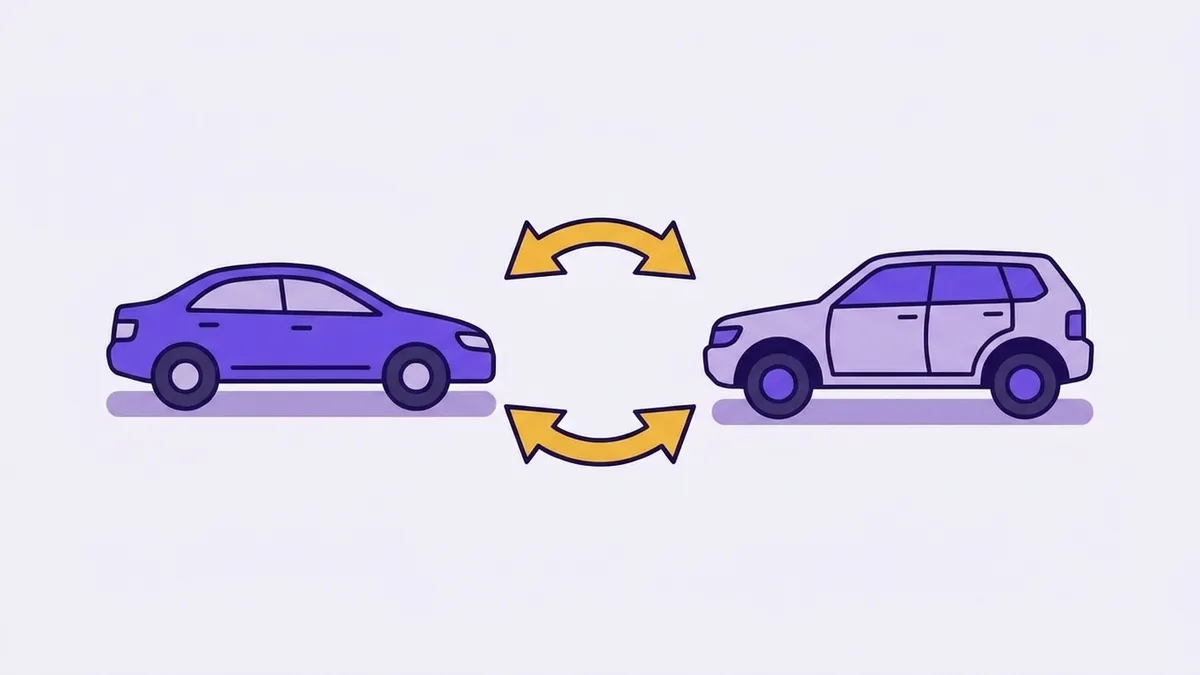
When you trade in a car you own, you sell it to the dealer and the dealer credits the price against your next car. A leased car isn't yours to sell. Your leasing company owns it and holds the title, so a “lease trade-in” is really the dealer buying the car from your leasing company at the payoff, then crediting you whatever is left over. If nothing is left over, there is nothing to trade: you return the car at the end of the lease, and the gap is your leasing company's to absorb.
That structure is why three parties get a say. Your leasing company decides whether that dealer may buy the car at all. The dealer decides what the car is worth, which sets your equity. And your state decides whether the trade reduces the sales tax on your next car. We'll take them in that order.
Can You Trade In a Lease at Any Dealer? Your Leasing Company Decides
Several of the largest captive lessors limit who may buy a leased car to the lessee or a dealer of their own brand: GM Financial says it does not process lease purchases through non-GM dealerships, and American Honda Finance announced in July 2021 that lessees who don't buy the car must return or trade it in at a Honda or Acura dealer. Our third-party buyout guide lists where each large lessor stands, with links to our detailed guides on GM Financial, Honda Financial, Ford Credit (where every purchase runs through a Ford dealer) and others.
One more thing to check at the dealer: the dealer usually gets its own payoff quote from your leasing company. Ask which figure it is using and compare it to the payoff on your own account. Our Chase Auto guide shows what to ask when a lessor's own pages say nothing about dealer purchases.
Trading In a Leased Car With Equity (and Why Negative Equity Isn't Yours)
A dealer taking your lease in trade is buying inventory, so the offer is a wholesale number, not what the car would bring on a retail lot. That isn't a trick; it is how trade-ins work. It does mean the equity you hear about at the dealership is the equity after the dealer's margin. Say your payoff is $21,000 and the dealer offers $23,500: you have $2,500 of equity, credited toward the next car. If the offer is $19,500 instead, there is no equity and no reason to trade: keep driving to the end of the lease and hand the car back, and that $1,500 is your leasing company's loss, not yours. Whether there is equity at all depends on the used market, which our guide to used-car prices and your buyout covers. Our equity guide shows how to calculate your own.
The harder problem is visibility. In a trade, your equity is credited inside a new-car deal, alongside the new car's price, any add-ons and the financing. When all of that is negotiated at once, it is easy to lose track of what your old car actually brought.
Negative equity is where a lease differs from a car you own. On a car you own, owing more than it is worth is your problem, and the Federal Trade Commission warns that some dealers roll that shortfall into the new car loan, so you still end up paying it. On a closed-end lease, which is nearly every consumer lease, the shortfall belongs to the leasing company. If the payoff is more than the car is worth, you don't trade it in. You return it at the end of the term, pay the usual turn-in charges, and walk away. A dealer who offers to “trade in” an underwater lease and roll the difference into your next contract is asking you to pay your leasing company's loss.
The one exception is when the car is underwater because of how it was driven. If you are far over the mileage allowance, or the car has damage the inspection will charge for, the turn-in bill can run into the thousands, and those charges disappear the moment the car is bought instead of returned. Then the comparison is the turn-in bill against the shortfall, and buying the car, or trading it, can be the cheaper exit. Our guide to over-mileage turn-in costs runs that math.
So ask for these as separate lines, in writing:
- The payoff the dealer will send to your leasing company, with its good-through date.
- The trade value the dealer is giving you for the car.
- The difference, and exactly where the credit appears on the new contract (as a down payment or a capitalized cost reduction). If the difference is negative, there is nothing to trade; return the car instead.
If a dealer won't break them out, be cautious about signing.
Do You Get a Trade-In Tax Credit on a Leased Car?
Many states let the value of a trade-in reduce the sales tax on your next car. Whether a car you are still leasing counts is a separate question, because you don't own it, and the answer changes at the state line. Here is what the official sources say in five states we cover in detail:
- Florida: no credit on a leased car. The state's title procedure says a lessee who trades a leased car toward buying another gets no trade-in allowance, “because the lessee is not the actual owner of the motor vehicle that was being traded in.” A car you own, traded at a dealership, is taxed on the difference like any other trade. See our Florida guide.
- New Jersey: no credit while leased, yes after a buyout. In its automotive tax guide, in the answer on the trade-in credit, the Division of Taxation says “a lessee may not trade in a leased motor vehicle,” but once the lessee has bought it out, it can be used as a trade-in. See our New Jersey guide.
- Idaho: conditional. The State Tax Commission's dealer guidance says a leased car taken in trade reduces the taxable price only if the lease was paid in full and sales tax was paid on the buyout. Idaho's rule also says that when a lessee hands the purchase option to the dealer, no credit is given for the residual the dealer pays; only the part of the trade allowance above that residual can reduce the taxable price. See our Idaho guide.
- Ohio: only toward a new car. Once the car is yours, Ohio's trade-in credit applies only when you trade toward a new vehicle from a new-car dealer; a used-car purchase gets no credit. See our Ohio guide.
- Pennsylvania: tax on the difference. When a trade-in happens at the same time as the sale, Pennsylvania taxes the purchase price minus the trade-in, and a car you have bought out is yours to trade. See our Pennsylvania guide.
The practical point: in a state that denies the credit on a leased car, trading in the lease can mean paying tax on the full price of the next car. Buying out first usually adds a tax bill on the buyout itself, and in return the later trade may earn the credit. Which total is lower depends on your numbers, so run both.
Florida shows how that math works out. Trade in the lease and the next car is taxed on its full price. Buy out first and you pay the 6% state tax on the buyout, then the next car is taxed only on its price minus the trade. Net, buying out first saves state tax equal to 6% of your equity, before the county surtax on the buyout, title fees and any loan interest. With the $2,500 of equity above, that is $150, which those costs can easily exceed. With $8,000 of equity, it is $480. Either way, it is a number to work out, not a reason on its own.
In any other state, ask the dealer in writing how the trade will be taxed before you sign. And if the car is worth less than the payoff, returning it at maturity is the exit: the shortfall stays with the leasing company, and you owe only the usual turn-in charges. Our guide to sales tax on a lease buyout covers how each state taxes the buyout itself.
Can You Trade In a Leased Car Early?
Yes, and what the dealer pays is an early purchase payoff, not an early-termination charge. Before the end of the lease, that payoff still contains the depreciation you haven't paid through your monthly payments. That makes it higher early on, so compare it with what the car is worth today, not with the residual printed in your contract, before you plan the trade. Our early buyout guide explains what is inside that quote.
The distinction matters. Termination ends the lease and hands the car back to the lessor; a trade-in sells the car to the dealer, and the lease ends because it has been paid off. If anyone quotes you a termination figure for a trade, ask for the purchase payoff instead. And until your leasing company receives the dealer's payment, the lease is still in your name, so confirm the account shows paid in full.
Trade In vs. Buy Out vs. Keep
A trade-in is one of three ways to get out of a lease with your equity. Here is how they line up.
| Path | Where the equity goes | Whose permission you need | Tax | Paperwork |
|---|---|---|---|---|
| Trade in the lease | Credited by the dealer inside the new deal, at a wholesale value. With no equity, return the car instead; the shortfall is the leasing company's. | Your leasing company must allow that dealer to buy. Often your brand's dealers only. | No credit on a leased car in Florida or New Jersey; in Idaho, only the allowance above the residual counts. Ask in any other state. | The dealer pays off the lease and handles the title with your leasing company. |
| Buy out, then trade or sell | Yours. It is credited at the later trade, or paid to you when you sell. | Only your own purchase option. Once the car is yours, you choose the buyer. | Tax on the buyout in most states; the later trade may earn a credit (Florida; New Jersey; Idaho if tax was paid; Ohio toward a new car; Pennsylvania on the difference). | A buyout loan, the car titled to you, then the sale or trade. |
| Buy out and keep | Stays in the car you now own. | Only your own purchase option. | Tax on the buyout, per your state's rules. | Financing arranged through partner lenders; we handle title and registration. |
Some lessors route even your own purchase through their dealers (Ford Credit always, and GM Financial in ten states), so “only your own purchase option” can still mean a dealer does the paperwork. It does not mean the dealer gets the car.
When Buying Out First, Then Trading, Makes Sense
The two-step path earns its extra steps in three situations: your leasing company won't let the dealer you want buy the car, your state gives no trade-in credit on a leased car, or you think the car will bring more from another buyer than from the dealer selling you your next car. In each case, owning the car first puts you in charge of who buys it and on what terms.
It isn't free. You pay tax on the buyout in most states, title and registration fees, any processing fee and interest on the buyout loan for as long as you hold it. If the only reason to buy out is to trade right away, those costs have to be smaller than what the two-step gains you. If they aren't, the direct trade-in is the better deal. Our guide to lease buyout fees lists each charge and who sets it.
If you go this way, the buyout works like any other: you exercise the purchase option, a lender funds the payoff, and the car is titled in your name with the lender as lienholder. When you trade the car later, the dealer pays off that loan the same way it would on any financed car. Title transfers take time, so read how the title transfer works and ask the next dealer what it needs before you plan a quick trade. California readers who plan to resell right away should also read the 10-day resale rule in our California guide; it has strict conditions.
Or Keep It: The Keep-It Path We Handle
Sometimes the numbers say the best trade is no trade. If the car has equity, fits your life and has miles left in it, keeping it means the equity stays with you instead of being credited at a wholesale value, and the keep-or-return decision has its own guide if you're on the fence.
Start with your license plate or VIN and we pull your payoff, check your equity and run the numbers, with no credit pull to see your estimate. If keeping the car is the right move, financing is arranged through partner lenders: your specialist chooses the lender or lenders with you and tells you before any inquiry. Our partner lenders can finance the sales tax and title fees into the loan along with the payoff and our fee, subject to lender credit approval. The title, registration and plates are handled for one flat $695 fee, with no DMV trip in most states. Try the buyout calculator or get your buyout options.
Common Questions
Can I trade in my leased car for a different brand?
It depends first on your leasing company. Several large captive lessors limit who may buy a leased car to the lessee or their own brand’s dealers. GM Financial says it does not process lease purchases through non-GM dealerships, and American Honda Finance announced in July 2021 that lessees who do not buy must return or trade in the car at a Honda or Acura dealer. Our guides on each lessor cover their published policies. If your lessor says no, the route to another brand is to buy the car out first. Once it is yours, any dealer can take it in trade.
Can I trade my leased car for a cheaper car?
Yes, if your leasing company lets that dealer buy it, or after you buy it out. Positive equity reduces what you owe on the cheaper car. If there is no equity, trade nothing: return the lease at the end of its term and buy the cheaper car on its own. Before you decide, compare what the dealer credits you against what the car would bring if you bought it out and sold it yourself, and check how your state taxes each path.
Can I trade in my leased car for a new lease?
Yes, where your leasing company allows that dealer to buy. Positive equity becomes a capitalized cost reduction on the new lease, so ask for it as its own line. If there is no equity, do not let a shortfall be added to the new lease’s capitalized cost; return the car at maturity and start the new lease clean.
Can I trade in my lease early?
Usually, yes, subject to the same rules on which dealers may buy. The dealer pays your leasing company the early purchase payoff, which still includes depreciation you have not paid through your monthly payments, so check it against what the car is worth today, not against the residual, before you count on any equity. That payoff is not an early-termination charge: termination returns the car to the lessor, while a trade-in sells it to the dealer. Ask the dealer to show you the exact payoff it will send.
Does trading in a leased car affect my credit?
Handing the lease to a dealer usually does not require a credit application by itself. Financing the next car does, the same as any car loan or lease. If you keep the car instead, there is no credit pull to see your estimate; when you decide to go ahead, your specialist chooses the lender or lenders with you and tells you before any inquiry.
What happens if I owe more than the car is worth?
On a lease, nothing, as long as you return the car. In a closed-end lease the gap between the payoff and what the car is worth is the leasing company’s risk, not yours, so you hand the car back at the end of the term and owe only the usual turn-in charges: the disposition fee, excess mileage and excess wear. Do not let a dealer roll that gap into a new loan; the FTC warns that some try. The exception is when the turn-in charges themselves would be large, such as thousands in mileage overage. Those charges disappear when the car is bought, so buying it or trading it can then beat returning it.
Do I need the title to trade in my leased car?
No. On a lease, the leasing company owns the car and holds the title. In a lease trade-in the dealer pays your leasing company the payoff, and the title moves from the lessor to the dealer. You bring your lease account details, registration and keys, and the dealer tells you what else it needs. If you buy the car out first, the car is titled in your name with your lender as lienholder, and you trade it like any other financed car.
Sources: Florida Highway Safety and Motor Vehicles, procedure TL-08 (Sales and Use Tax), question 18; New Jersey Division of Taxation, Consumer Automotive Tax Guide, questions 28 and 29; Idaho State Tax Commission, Sales Price: Motor Vehicles, Dealers, and IDAPA 35.01.02.044.07; Ohio Revised Code 5739.01(H)(2); 61 Pa. Code § 31.44; Federal Trade Commission, Auto Trade-Ins and Negative Equity; lessor policies as published by GM Financial, American Honda Finance Corporation (July 8, 2021) and Ford Credit, detailed in our guides on each. Rules current as of September 2026 and subject to change; confirm with your leasing company and your state. Lease Solutions is not affiliated with or endorsed by any leasing company named here. This is general information, not financial or tax advice.